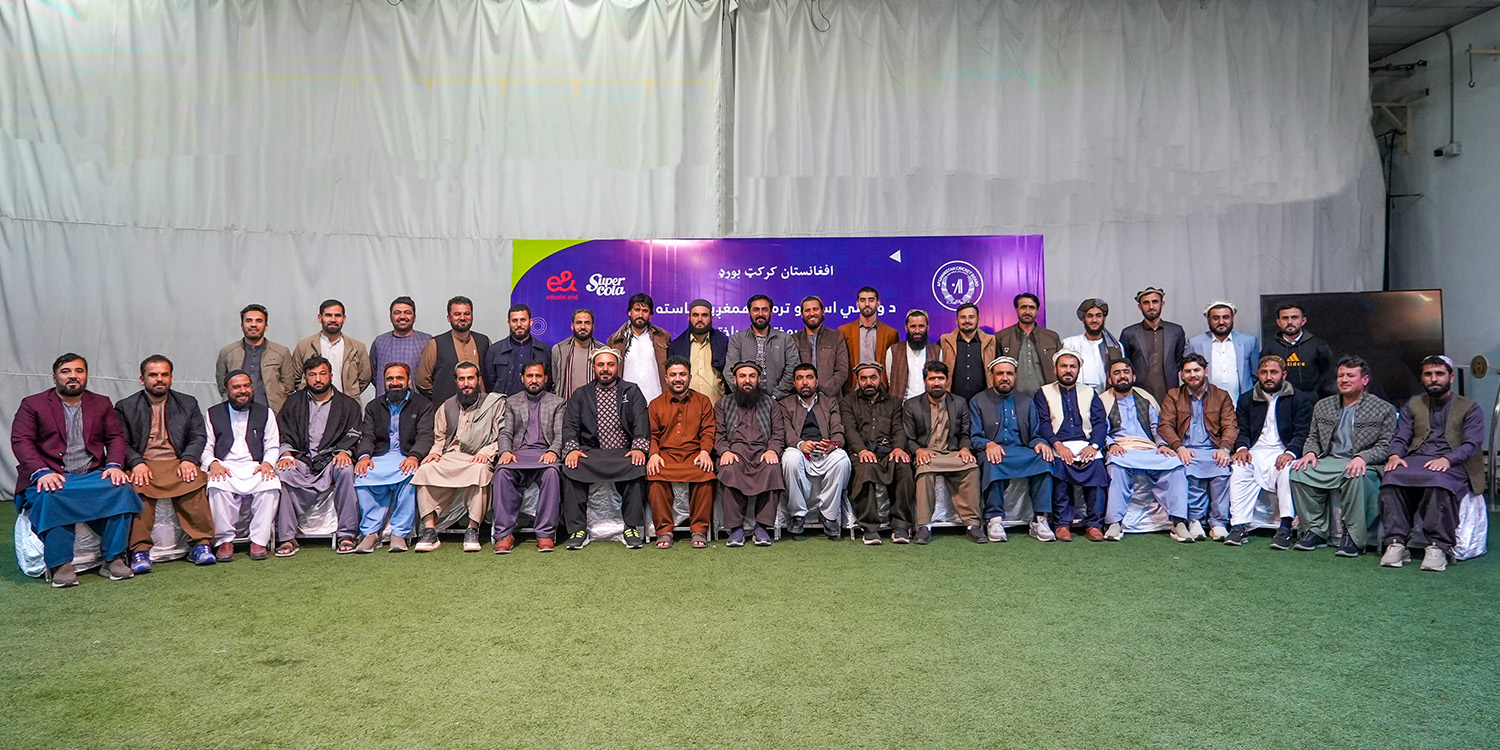
Kabul – February 18, 2026: The Afghanistan Cricket Board (ACB) conducted a coordination meeting with all provincial cricket development managers at its main office, led by the Domestic Cricket Department. This two-day meeting focused on enhancing collaboration between provinces, increasing the number of matches, construction initiatives, improving services, and advancing cricket development at the provincial level.
The meeting was held on February 16 and 17. On the first day of the
workshop, a representative from each region presented reports on their
respective regions from the past year, covering both their achievements and the
challenges faced. In response to these reports, Shukrullah Haider, the CEO's
Office Manager, and Nazim Jar Abdulrahimzai, head of Domestic Cricket,
addressed the challenges raised.
During the meeting, managers from provinces that effectively
implemented the 2025 annual operation plans were praised. Additionally, on the
second day, new changes and plans for the upcoming year were shared with
provincial managers through a presentation. Representatives from all five
regions were consulted in finalizing the New Year’s plan.
The meeting emphasized the accurate registration of players according
to the new plan, ensuring that they play their inter-club matches within their
respective provinces. It was decided to charge a reduced event fee of
approximately 8,500 Afghanis for club-level matches. In provinces lacking a
National Ground or if such grounds are already booked, clubs will cover the
costs of private grounds. However, this will be managed through the ACB’s
central office following an established procedure at a reasonable cost.
Moreover, it was decided to register a total of 13 players per team for
club-level matches to improve overall quality. Provincial representatives were
strongly encouraged to prioritize quality when registering clubs to identify
more talented players for higher-level competitive cricket.
With this aim, it was determined that in club-level competitions, six
teams will compete in each group, and only the players from the top four teams
will be eligible for selection for the Provincial Grade II tournament. The
remaining two teams will be eliminated, and their players will not be
considered for higher-level competitions.
Instructions were also provided regarding the organization of various competitions, including school-level events, university cricket, district cricket, inter-academy matches, corporate events, and competitions at different age levels.
The meeting stressed that One-Day and Two-Day matches, as well as
bilateral series, must be organized between provinces and regions.
Additionally, the Regional Head Coach is expected to regularly visit academies
in their respective regions throughout the year, organize camps for
top-performing players and share insights and guidance with provincial coaches.
There was a strong emphasis on developing and expanding cricket across
all provinces. According to a comprehensive plan, provincial representatives
from each region are required to hold their own internal meetings to ensure the
regular implementation of cricket growth and development plans.
Officials from the ACB’s Human Resources department also presented
information about employee policies to provincial representatives, while the
Administration department provided insights on effective administrative
procedures and coordination.
At the end of the meeting, consultations were held among
representatives regarding the organization of bilateral series. They
subsequently shared their plans with the Domestic Cricket Department for approval.
It is noteworthy that the Afghanistan Cricket Board held a similar
workshop and training meeting for all provincial managers last year, which
proved to be very effective and impactful, leading to improved cricket standards
in the provinces.